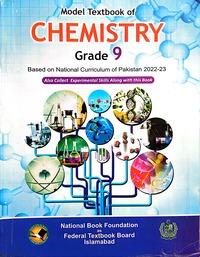
Study chapter-wise, SLO-based Class 9 Chemistry solved notes prepared according to the latest Federal Board syllabus and NBF textbook. Access solved exercises, conceptual MCQs, short questions, long questions, and exam-focused revision material.
Federal BoardClass 9SSC-IChemistryEnglish MediumSession 2026-2027SLO BasedSNC AlignedNBF TextbookChapter-Wise Notes
Quick Answer
The 9th Class Chemistry Notes FBISE page offers complete, chapter-wise solved notes for Federal Board SSC-I students based on the latest 2026-2027 National Book Foundation (NBF) textbook. Students can access detailed step-by-step solutions to textbook exercises, concept-focused MCQs, important short questions, and long questions. Designed in line with the Single National Curriculum (SNC) and Student Learning Outcomes (SLO) guidelines, these notes are perfect for exam revision, class tests, and board preparation.
Chapter-Wise Chemistry Notes
Select any chapter to read online or download the PDF notes for exam preparation.
Chapter 1
Nature of Science in Chemistry
Understand the branches of chemistry including physical, organic, inorganic, analytical, biochemistry, environmental, and industrial chemistry. Explore daily life applications and the relationship between science, technology, and engineering.
Examine states of matter, elements, compounds, and mixtures. Study allotropes of carbon (graphite, diamond, buckyballs C-60) and solutions (aqueous, saturated, unsaturated, supersaturated), solubility, colloids, and suspensions.
Explore atomic models from Dalton, Rutherford, and Bohr to the Quantum Mechanical Model and Heisenberg Uncertainty Principle. Study subatomic particles, charge neutrality, relative atomic mass (amu), isotopes, cations/anions, and electronic configuration.
Study the layout of the periodic table including periods, groups, blocks (s and p), and transition elements. Understand periodicity of properties like shielding effect, atomic size, ionization energy, electron affinity, electronegativity, halogens, and noble gases.
Learn why atoms react and form chemical bonds. Explore types of bonds (ionic, covalent, coordinate covalent bonds like ammonium/hydronium ions) and intermolecular forces (dipole-dipole, hydrogen bonding). Study metallic bonding and property contrasts.
Master empirical and molecular formulas, formula mass, naming binary ionic compounds, and Avogadro's number/mole concept. Practice mole-mass and mole-particle calculations, and balancing chemical and ionic equations.
Understand oxidation and reduction reactions in terms of oxygen, hydrogen, and electron transfer. Learn rules for assigning oxidation states, oxidizing/reducing agents, and methods of corrosion prevention like galvanizing and cathodic protection.
Explore chemical thermodynamics including systems and surroundings. Study thermochemical reactions (exothermic and endothermic), enthalpy of reaction, bond energy, activation energy, catalysts, and biological respiration.
Study reversible reactions and dynamic equilibrium conditions. Explore how heat and temperature affect chemical equilibrium, and analyze classroom activities involving hydrated copper(II) sulphate.
Compare Arrhenius and Bronsted-Lowry concepts of acids and bases. Understand strong/weak acids and bases, pH scale, properties of acids/bases, and oxides/hydroxides.
Analyze the composition of the atmosphere and key air pollutants (SOx, CO2, CO, methane, ozone). Study global warming, acid rain mitigation, catalytic converters, reforestation, and personal protective measures.
Explore properties of water as a solvent, water quality, and natural substances (dissolved oxygen, minerals vs. harmful compounds). Understand tap water treatment, waterborne diseases, water scarcity in Pakistan, and fertilizers.
Study organic compounds, homologous series, and structural formulas. Learn the classification of open/closed chain compounds and key functional groups including haloalkanes, alcohols, phenols, ethers, carboxylic acids, esters, and amines.
Understand alkanes, including preparation methods like hydrogenation of alkenes/alkynes, reduction of alkyl halides, and cracking of larger hydrocarbons. Explore alkane properties like halogenation and combustion.
Explore carbohydrates (source of energy, classification), proteins, lipids, and nucleic acids (DNA/RNA). Learn about healthy nutrition, daily intake requirements for young adults, and basic food components.
Learn SI units, unit conversions, scientific notation, and accuracy/precision. Study laboratory measurement tools like volumetric pipettes, burettes, gas syringes, and balances, including experimental pros/cons.
Study laboratory techniques for the detection of gases (ammonia, carbon dioxide, chlorine, hydrogen, oxygen, sulphur dioxide). Learn how to perform flame tests to detect metal cations.
Understand the principles of chromatography including stationary and mobile phases. Practice paper chromatography procedures, using locating agents, reading chromatograms, and identifying unknown substances.
Welcome to the ultimate learning resource for 9th Class Chemistry under the Federal Board of Intermediate and Secondary Education (FBISE). Chemistry is the branch of science that deals with the composition, structure, properties, and reactions of matter. To help SSC-I students master the periodic table, chemical bonding, and complex stoichiometric calculations, we have developed this comprehensive set of solved notes based on the National Book Foundation (NBF) textbook.
For the 2026-2027 session, FBISE has fully adopted the Student Learning Outcomes (SLO) model. The exams assess students' conceptual understanding and practical analytical skills rather than rote memorization. Our notes address this standard by providing detailed explanations of chemical principles, step-by-step calculations for moles and balancing equations, and clear diagrams for laboratory techniques and atomic structure models.
Whether you are analyzing oxidation states in Chapter 7, studying environmental impacts on air and water in Chapters 11 and 12, or learning separation techniques in Chapter 17, our solved exercises are designed to build confidence. Read these notes online or download the chapter-wise PDF guides to establish a strong foundation for your chemistry exams and future scientific studies.
What Are These Chemistry Notes?
These study notes are a complete educational guide tailored specifically for Federal Board (FBISE) Class 9 Chemistry students. They serve as a comprehensive companion to the official NBF textbook, simplifying complex topics and offering high-quality solutions for all theoretical and practical queries.
Our solutions focus on clear chemical reasoning, precise definitions, and step-wise calculations. This structured approach is crucial for scoring well under the board's marking scheme, where logical explanations and correct units are highly valued.
Here is what these Class 9 Chemistry solved notes cover:
Chapter-wise summaries and important key definitions
Fully solved textbook exercise questions with clear explanations
Conceptual multiple-choice questions (MCQs) for objective paper prep
SLO-based short questions to practice conceptual application
Detailed long-answer questions explaining reaction mechanisms and theories
Step-by-step guides for chemical calculations and balancing equations
Illustrations of atomic models and chemical bonding structures
Practical guides for laboratory techniques and gas identification
Revision checklists for quick preparation before tests and annual exams
Using these notes regularly alongside your class lectures will help you clarify doubts and master fundamental chemical concepts.
What Is Included in the Notes?
Students can use the chapter-wise material to access the following learning resources:
✓
Solved Exercises
Step-by-step solutions to all National Book Foundation (NBF) textbook questions with detailed chemical explanations.
A
MCQs
Concept-focused multiple-choice questions with correct answers and explanations to secure full marks in the objective section.
Q
Short Questions
Conceptual short-answer questions designed to evaluate the student's understanding of chemical reactions and principles.
L
Long Questions
Comprehensive answers for detailed topics such as atomic models, bonding theories, and environmental cycles.
D
Definitions
Standard, easy-to-learn definitions of chemical terms, laws, and units aligned with FBISE guidelines.
◎
Diagrams
Illustrations of atomic structure, chemical bonds, and laboratory setups to help students practice drawings for exams.
★
SLO-based Questions
Analytical and application-based questions mapped to Federal Board Student Learning Outcomes.
↓
PDF Download
Direct links to download chapter-wise notes for offline access and convenient revision before exams.
SNC and National Curriculum Alignment
These 9th Class Chemistry Notes are fully aligned with the Single National Curriculum (SNC) guidelines of Pakistan and the Student Learning Outcomes (SLO) model of the Federal Board (FBISE). The curriculum prioritizes critical thinking, chemical reasoning, and practical laboratory methods, preparing students for advanced studies in science and engineering. Our notes reinforce these objectives by focusing on underlying concepts, derivations, and structural representations rather than simple rote learning.
How to Prepare Class 9 Chemistry from These Notes
Follow this simple preparation method to get better results in Chemistry.
1
Read the textbook chapter first
Understand basic terms, atomic symbols, and chemical definitions from the NBF textbook before starting the solved exercises.
2
Revise key concepts
Use the chapter summaries in our notes to quickly go through the core concepts, theories, and laws of each chapter.
3
Solve MCQs
Practice the solved conceptual MCQs to build speed and accuracy for the objective section of the board paper.
4
Prepare short questions
Study short answers and pay attention to scientific explanations and correct chemical symbols.
5
Prepare long questions
Go through long questions to learn the structured heading format, which is essential for presenting long answers effectively.
6
Practice diagrams and calculations
Draw electron configurations and molecular structures, and solve numerical mole-mass calculations repeatedly on paper.
7
Revise before tests and board exams
Go through the notes, solved papers, and formula checklists again before tests to consolidate your preparation.
Related Resources
Use these resources to complete your Chemistry preparation and other subjects.
These are chapter-wise solved notes for Federal Board Class 9 Chemistry students, supporting the National Book Foundation (NBF) textbook. They include step-by-step exercise solutions, conceptual MCQs, short questions, and long questions.
Are these Chemistry notes based on the latest NBF syllabus?
Yes, these notes are fully updated for the 2026-2027 academic session, aligning with the new NBF chemistry textbook prescribed for Class 9 by the Federal Board.
Are these notes SLO based?
Yes. The notes follow the Student Learning Outcome (SLO) guidelines of the Federal Board, emphasizing conceptual understanding, practical application, and experiment-based learning over rote memorization.
Are the textbook exercise questions fully solved in these notes?
Yes, every exercise question in the textbook has been solved step-by-step with clear chemical reasoning to help students secure full marks in exams.
Do these notes include solved MCQs?
Absolutely. The notes contain chapter-wise conceptual MCQs with correct answers and detailed explanations to prepare students for the objective section of the board exams.
Can I download the Class 9 Chemistry notes as PDF?
Yes. PDF download options are available on the respective chapter pages, allowing students to save files for offline study and quick revision.
Are these notes helpful for Federal Board annual exams?
Yes, they are highly useful. They align with the board's exam pattern, cover all exercise questions, explain chemical bonding and equations, and provide practice for SLO-based questions.
Are these notes suitable for weak students?
Yes, the simplified explanations, point-wise answers, and chemical calculation strategies are designed to help students of all learning levels grasp complex chemistry concepts easily.
Is the new 2026-2027 syllabus aligned with the Single National Curriculum (SNC)?
Yes, the Federal Board Class 9 Chemistry syllabus and NBF textbook are fully aligned with the Single National Curriculum (SNC) guidelines of Pakistan.
Can Punjab Board students use these notes?
While these notes target the NBF textbook for FBISE, Punjab Board students can also use them to prepare similar topics such as Atomic Structure, Chemical Bonding, and Electrochemistry.
What is covered in Chapter 3: Atomic Structure?
Chapter 3 covers atomic models (Dalton, Rutherford, Bohr), Quantum Mechanical Model, subatomic particles, atomic number and mass number, isotopes (hydrogen, carbon, chlorine, uranium), relative atomic mass, amu, cations and anions, and electronic configuration of atoms and ions.
How do I use these notes for self-study and revision?
Start by studying the concepts from the textbook, then review the solved answers in these notes, practice balancing chemical equations, and revise the quick definitions regularly.
Are chemical calculations and formulas explained in these notes?
Yes, all key chemical calculations such as mole-mass and mole-particle calculations, and structural formulas are clearly illustrated and explained step-by-step to help students practice.
Educational Notice: This content is provided for educational support only. It is not for sale, redistribution, or commercial use. StudyPlusPlus is not claiming official ownership of any government textbook material.