Chapter 1
Notes + Exercise LinkComputer Systems
Understand numbering systems, conversion of decimal, binary, octal, and hexadecimal bases, ASCII/Unicode coding schemes, Operating System functions, and application software hosting.
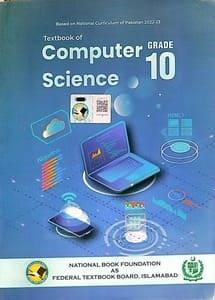
Get free access to chapter-wise solved exercises, conceptual MCQs, short and long questions, and PDF download links aligned with the latest National Book Foundation (NBF) textbook.
Looking for the latest Class 10 Computer Science notes for Federal Board (FBISE)? StudyPlusPlus provides comprehensive, SLO-based solved notes for the 2026-2027 session based on the National Book Foundation (NBF) textbook. Our guide covers all chapters with solved textbook exercises, conceptual MCQs, short-answer questions, and detailed long-answer questions to help you ace your SSC-II board exams.
Select any chapter to read online or download the PDF notes for exam preparation.
Understand numbering systems, conversion of decimal, binary, octal, and hexadecimal bases, ASCII/Unicode coding schemes, Operating System functions, and application software hosting.
Learn counting problems and principles (permutations, combinations, pigeonhole), algorithm properties, logical reasoning (Boolean logic), sorting/searching algorithms, modular design, and dry running code.
Explore website development basics, interactive HTML/CSS forms and tables, CSS animations, JavaScript complex control structures, list algorithms, and advanced unit testing and debugging techniques.
Dive into data science, AI, and Machine Learning models (supervised, unsupervised, reinforcement). Study data visualization charts, benefits, and the stages of the Data Science Life Cycle.
Discover Internet of Things (IoT) sensors, blockchain supplies, cloud storage utility, voice recognition platforms, natural language processing applications, robotics, and AI design ethics.
Examine tech addiction issues, privacy cookies/spam threats, public vs private cloud security policies, cybersecurity laws, cyberbullying prevention strategies, and the digital divide's socioeconomic gaps.
Develop skills in digital search, information extraction, graphic representations of ideas, designing professional posters or billboards, and leveraging social media channels for communication.
Master qualitative vs quantitative market research methodologies, survey questionnaire designs, product market validation strategies, customer persona profiling, and pitch deck creation.
Welcome to the ultimate resource for Class 10 Computer Science preparation under the Federal Board of Intermediate and Secondary Education (FBISE). With the transition towards Student Learning Outcomes (SLO) based examinations, reliance on traditional rote learning is no longer sufficient. Our notes are specifically compiled to align with the National Book Foundation (NBF) curriculum, guiding students through practical concepts and theoretical frameworks smoothly.
The Class 10 syllabus covers a diverse range of modern topics. It transitions from core hardware and operating system architectures to logic, coding, data analysis, and advanced topics such as machine learning and blockchain. Our chapter-wise notes provide clear definitions, step-by-step procedures, and visual flowcharts that make complex computing paradigms easy to grasp for high school students.
By utilizing these study guides, you will gain access to detailed solutions for all textbook exercise problems, conceptual objective questions, and targeted prep sections. Whether you want to master JavaScript arrays, analyze data science life cycles, or secure devices from cyber threats, this portal offers complete academic support for all SSC-II students.
These study resources serve as a comprehensive companion to the official National Book Foundation (NBF) textbook for Class 10 Computer Science. Every topic listed in the curriculum has been broken down into structured, exam-oriented study materials to ensure students can study systematically.
Our educational content focuses on clarity and context. We prioritize explainers for SLO-based questions that test analytical thinking and problem-solving abilities rather than simple memorization of answers.
In addition to standard textbook solutions, these notes cover critical learning aids including:
Students can use the chapter-wise material to access the following learning resources:
Step-by-step solutions to all end-of-chapter textbook questions, including programming and numbering conversions.
Conceptual multiple-choice questions designed to test your knowledge of coding, logical structures, and digital terms.
Brief, precise answers to critical topics such as coding schemes, counting principles, and security methods.
Detailed, comprehensive explanations with structured sections covering operating systems, IoT, and data cycles.
A clear glossary of technical definitions including machine learning, algorithms, supply chain blocks, and cyberbullying.
Labeled visual maps, cloud computing configurations, and flowchart models to aid visual learners.
High-quality conceptual questions prepared in accordance with the latest Federal Board assessment guidelines.
Downloadable chapter-wise notes so you can keep studying offline on any device.
These Class 10 Computer Science notes are fully aligned with the Single National Curriculum (SNC) guidelines and the Student Learning Outcomes (SLO) assessment framework approved by the Federal Ministry of Education. The curriculum is designed to promote computational thinking, programming logic, data intelligence, and digital ethics, preparing students for SSC-II board examinations under the National Book Foundation (NBF) publishing standards.
Follow this simple preparation method to get better results in your computer science board exams.
Always start by reading the official NBF textbook to familiarize yourself with the concepts, numbering systems, and coding structures.
Review the summary notes and definitions to reinforce your memory of core technical definitions and programming theories.
Attempt the conceptual multiple-choice questions to self-assess your understanding of details in operating systems and data sciences.
Practice writing short answers that directly address the core question, keeping them focused and clear for examiners.
Learn to structure long answers with proper headings, bullets, comparisons, and architecture steps.
Draw flowcharts, cloud configurations, and IoT block structures to ensure clarity in visual questions.
Go through the quick review guides and lists just before tests to keep important concepts fresh in your mind.
Use these resources to complete your Computer Science preparation and check adjacent subjects.
Yes, these solved notes are fully updated for the 2026-2027 academic session according to the National Book Foundation (NBF) textbook prescribed by FBISE.
Yes, these notes are structured around the Student Learning Outcomes (SLO) framework, helping students solve conceptual, logical, and application-based exam questions.
The Class 10 NBF textbook covers web design fundamentals using HTML and CSS, and programming logic using JavaScript.
Absolutely. Chapter 1 includes detailed step-by-step conversions between Decimal, Binary, Octal, and Hexadecimal systems, as well as binary arithmetic and complements.
Yes, Chapter 3 includes solved exercises for JavaScript arrays, conditional constructs, loops, interactivity logic, and debugging tools.
Yes, Chapter 4 provides a comprehensive breakdown of the Data Science Life Cycle from problem definition to model deployment, along with data visualization methods.
Yes, chapter-wise PDF download links are available so you can download and study the notes offline on your phone or computer.
Yes, each chapter features conceptual MCQs with explanations to prepare you for the objective section of the Federal Board paper.
Yes, the solutions and chapter order strictly follow the official textbook published by the National Book Foundation for Federal Board Class 10.
The notes break down complex programming blocks and network diagrams into simple, logical steps, making it easy for students of all learning levels to follow.
Yes, the textbook and these solved notes comply fully with the Single National Curriculum guidelines approved by the government.
While these notes are tailored to the NBF book for FBISE, the core computational concepts, HTML/CSS/JS constructs, and IoT/AI fundamentals are highly beneficial for Punjab Board students as well.